Responding to the Student Voice in Dual Enrollment: Insights From Focus Group Interviews and DESSE Survey Data
Responding to the Student Voice in Dual Enrollment: Insights From Focus Group Interviews and DESSE Survey Data By Aurely Garcia Tulloch & John Fink More than a million high school students are taking dual enrollment (DE) courses each year to get a jump start on college and career success, yet persistent gaps in access have […]
Promising Combinations of Dual Enrollment, AP/IB, and CTE: The College and Earnings Trajectories of Texas High School Students Who Take Accelerated Coursework

Promising Combinations of Dual Enrollment, AP/IB, and CTE: The College and Earnings Trajectories of Texas High School Students Who Take Accelerated Coursework By Tatiana Velasco, Wonsun Ryu, Lauren Schudde, Karissa Grano, Davis Jenkins & John Fink Using detailed administrative data from Texas on students who were expected to complete high school in 2015-16 and 2016-17 […]
College Business Models for Scaling Purposeful Dual Enrollment

College Business Models for Scaling Purposeful Dual Enrollment By John Fink, Davis Jenkins, Sarah Griffin & Aurely Garcia Tulloch There is a growing consensus that dual enrollment should be more than just an early taste of college; it should serve as a purposeful pathway to career-connected postsecondary education and training, particularly for students who might […]
The Link Between Dual Enrollment Partnership Characteristics and Outcomes: Findings From Texas
This working paper describes dual enrollment (DE) high school–college partnerships and estimates which DE structures and contexts predict aggregate DE course completion, college enrollment, and degree attainment.
The Postsecondary Outcomes of High School Dual Enrollment Students: A National and State-by-State Analysis
Using NSC data, this report presents national and state-by-state findings on the postsecondary enrollment and completion outcomes of high school students who began taking dual enrollment college courses in fall 2015, tracked for four years after high school.
What Do Dual Enrollment Students Want? Elevating the Voices of Historically Underserved Students to Guide Reforms
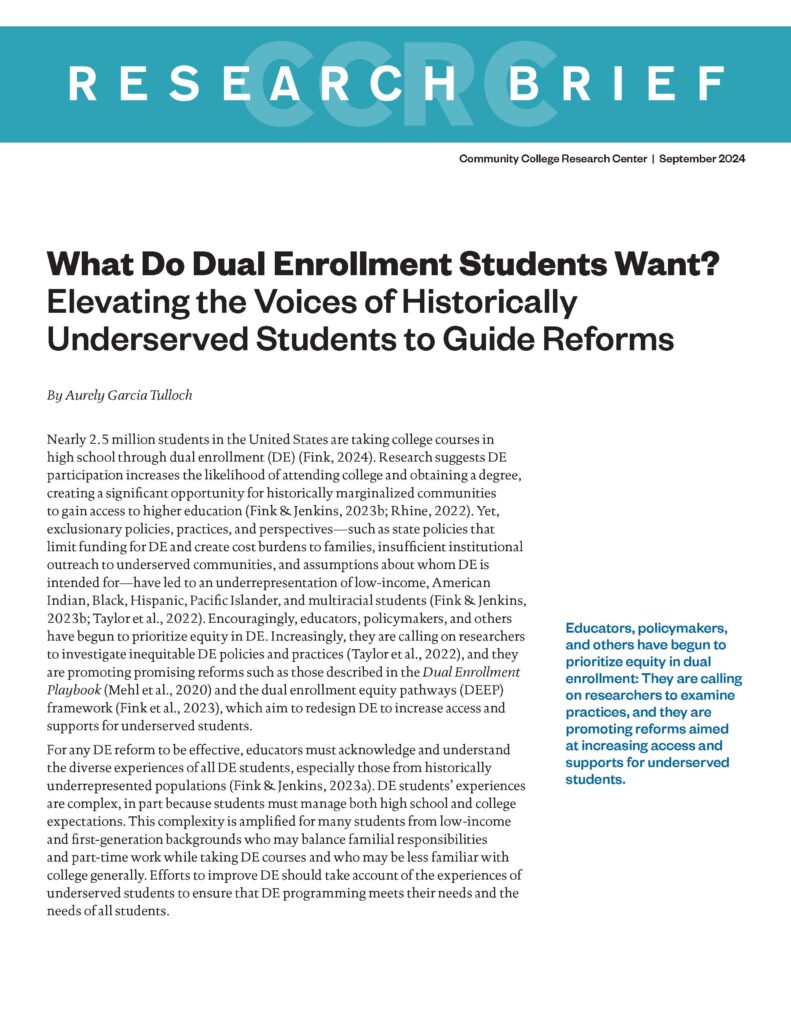
Based on focus group interviews with predominantly Black, Hispanic, and low-income students, this brief examines the experiences of students historically underserved in dual enrollment to understand what these students want from their programs and the educators who lead them.
Dual Enrollment Equity Pathways: A Research-Based Framework for Expanding College and Career Opportunity for Underserved Students
This article introduces “dual enrollment equity pathways” (DEEP)—a research-based framework for rethinking à la carte dual enrollment as a more equitable on-ramp to college programs of study that lead to high-opportunity career paths for students historically underserved in dual enrollment.
Understanding Dual Enrollment
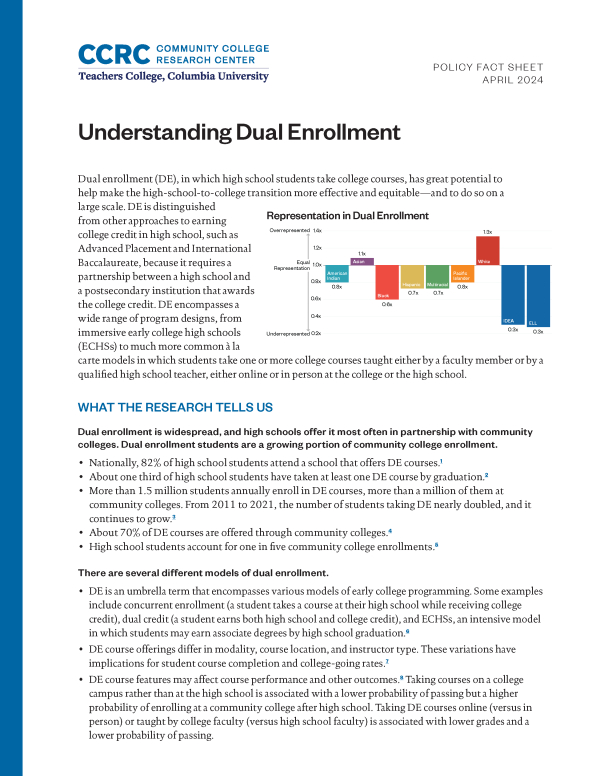
This fact sheet describes the growth of dual enrollment, the various models and funding mechanisms, and steps colleges and high schools can take to make dual enrollment more equitable.
“Waiving” Goodbye to Placement Testing: Broadening the Benefits of Dual Enrollment Through Statewide Policy
Using interview data from program leaders and statewide student data, this paper examines the implementation and estimates the effects of Ohio’s Innovative Programs, a policy aimed at expanding access to dual enrollment for underserved high school students.
How States and Systems Can Support Practitioner Efforts to Strengthen Dual Enrollment
How States and Systems Can Support Practitioner Efforts to Strengthen Dual Enrollment By Jessica Steiger, John Fink & Alex Perry With the expansion of dual enrollment (DE) programs in recent years, researchers have documented how college and K-12 practitioners are reforming DE to focus on broadening its benefits for all students. This report, co-authored with the College […]