Can Dual Enrollment Algebra Reduce Racial/Ethnic Gaps in Early STEM Outcomes? Evidence From Florida
Can Dual Enrollment Algebra Reduce Racial/Ethnic Gaps in Early STEM Outcomes? Evidence From Florida By Veronica Minaya Math is an integral subject in nearly all STEM disciplines, and early exposure to advanced math coursework may encourage high school students to enter and persist in STEM fields in college. This report examines whether taking college algebra […]
The Dual Enrollment Playbook: A Guide to Equitable Acceleration for Students
The Dual Enrollment Playbook: A Guide to Equitable Acceleration for Students By Gelsey Mehl, Joshua Wyner, Elisabeth A. Barnett, John Fink & Davis Jenkins More than a million high school students across the nation participate in dual enrollment each year. Dual enrollment students are more likely to graduate from high school, enroll in college, and […]
High School Dual Enrollment in Florida: Effects on College Outcomes by Race/Ethnicity and Course Modality
High School Dual Enrollment in Florida: Effects on College Outcomes by Race/Ethnicity and Course Modality By Vivian Yuen Ting Liu, Veronica Minaya, Qing Zhang & Di Xu This report presents findings on the relationship between taking community college dual enrollment courses—in which high school students earn high school and college credits simultaneously—and college outcomes among […]
Rethinking Dual Enrollment to Reach More Students
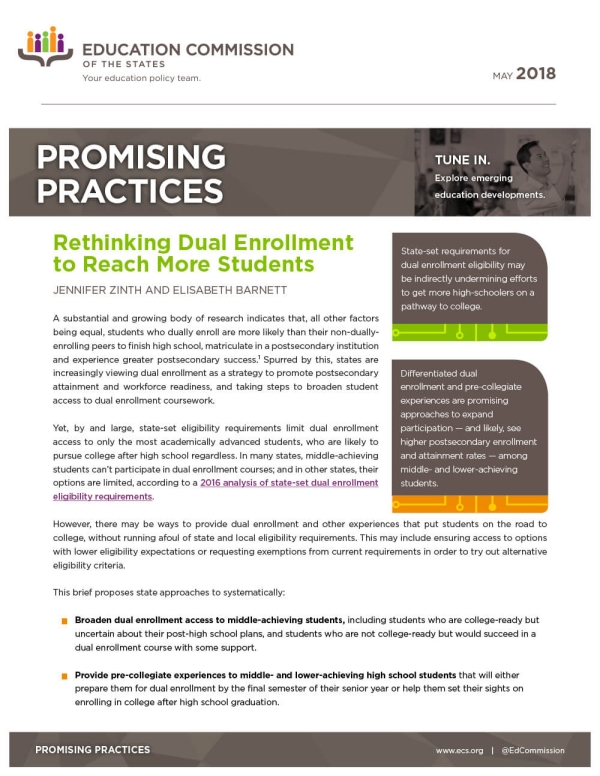
Rethinking Dual Enrollment to Reach More Students By Jennifer Zinth & Elisabeth A. Barnett Dual enrollment students are more likely to finish high school, matriculate in a postsecondary institution, and experience greater postsecondary success. Consequently, states are increasingly viewing dual enrollment as a strategy to promote postsecondary attainment and workforce readiness and are taking steps […]
What Happens to Students Who Take Community College “Dual Enrollment” Courses in High School?
What Happens to Students Who Take Community College “Dual Enrollment” Courses in High School? By John Fink, Davis Jenkins & Takeshi Yanagiura The number of students taking college courses while they are in high school has grown dramatically over the past two decades—particularly at community colleges—but many colleges and states do not track participants’ outcomes. […]
Dual Enrollment, Structural Reform, and the Completion Agenda
Dual Enrollment, Structural Reform, and the Completion Agenda By Melinda Mechur Karp This chapter addresses the intertwined issues of structural systems reform and college completion, as well as the role dual enrollment can play in ensuring equitable postsecondary outcomes for underrepresented students. This chapter appears in New Directions for Community Colleges, vol. 2015, no. 169. View […]
Dual Enrollment for College Completion: Findings From Tennessee and Peer States
Dual Enrollment for College Completion : Findings From Tennessee and Peer States By Melinda Mechur Karp, Katherine L. Hughes & Maria S. Cormier Commissioned by the Nashville Chamber of Commerce, this report reviews dual enrollment research and dual enrollment policies in Tennessee and five peer states—Florida, Texas, Georgia, North Carolina, and Kentucky. The states were […]
Dual Enrollment for College Completion: Policy Recommendations for Tennessee
Dual Enrollment for College Completion: Policy Recommendations for Tennessee By Melissa Mechur Karp Commissioned by a multi-organizational group of Tennessee stakeholders, this report makes a series of policy recommendations for strengthening dual enrollment in Tennessee to ensure that the program contributes to Tennessee’s college completion goals. The authors base their recommendations on interviews with key […]
Bridging College and Careers: Using Dual Enrollment to Enhance Career and Technical Education Pathways
Bridging College and Careers: Using Dual Enrollment to Enhance Career and Technical Education Pathways By Olga Rodriguez, Katherine L. Hughes & Clive Belfield Using longitudinal administrative data, this NCPR working paper compares outcomes of students who in 2008–09 and 2009–10 enrolled in one or more dual enrollment courses through the Concurrent Courses Initiative (CCI) in […]
Broadening the Benefits of Dual Enrollment: Reaching Underachieving and Underrepresented Students With Career-Focused Programs
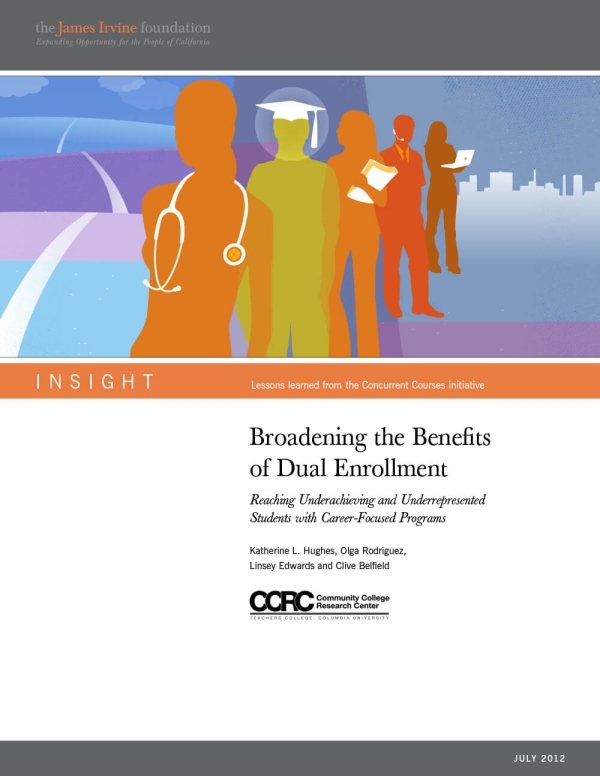
Broadening the Benefits of Dual Enrollment: Reaching Underachieving and Underrepresented Students With Career-Focused Programs By Katherine L. Hughes, Olga Rodriguez, Linsey Edwards & Clive Belfield This study suggests that career-focused dual enrollment programs—in which high school students take college courses for credit—can benefit underachieving students and those underrepresented in higher education. The study found that […]